
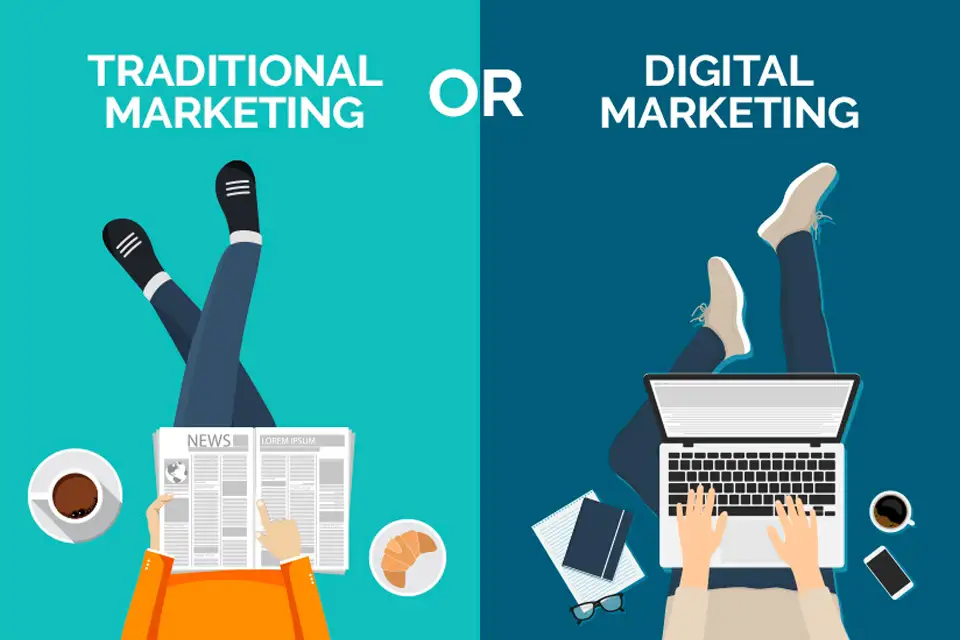
We are in 2026 and digital marketing dominating business growth has become an everyday affair. Under such circumstances traditional marketing sounds primitive and non-effective. But let’s not be so quick to draw conclusions. Detailed discussion of both the methods and a comparative study might help to determine which marketing strategy is ideal and most effective for the current era.
A long time back when digitalisation was a distant dream, traditional marketing was the only option. Businesses had to rely on TV channels, radio, bill boards and printed materials for promotion. But this strategy could reach their brand only to the local or regional audience. At the same time, the reliability factor was high in traditional marketing. People trusted their local newspaper, TV channels and other references that helped businesses gain customer trust and brand reliability. So, then why was there a need for digitalisation?
As the world became more connected over the internet, businesses felt the need of getting a global reach for their brand. Also, digital marketing allowed them to promote their brand on the go over a laptop, a tablet or even a smart phone. Switching to a marketing strategy that was not only faster but also cost effective helped them to reject the chance factor where brand visibility depended on how often their target audience watched TV Ads, or read a flyer or came across bill boards showcasing their product or services. The idea was to evolve with the changing world and make their brand more accessible with just a click.
But, did the rise of digital marketing mark the end of traditional marketing strategies? Why are more and more businesses investing in digital marketing? Or maybe 2026 holds better surprises for marketing trends where both digital and traditional marketing combine to give rise to a more complex competitive system.
Traditional Marketing in 2026: Where It Stands
Don’t get swayed by the digital boom around you. Even in these modern days, traditional marketing makes its way for businesses. But the way of doing it has definitely changed a lot. The main idea of this age-old method is to establish a strong local presence and build trust using older demographics. Traditional marketing is still chosen in 2026 for the following reasons –
- Superior tangibility
- Enhanced credibility
- Long-lasting impression
- Outcompete saturated digital spaces
How Traditional Marketing Has Evolved
Traditional marketing has very well adapted to the everchanging business marketing landscape. A major upgrade has taken place in TV ads, bill boards and flyer creations. Some of the most eye-catching changes in traditional marketing that has set the pace in 2026 include –
- Phygital integration
This involves combining physical methods with digital strategies (physical + digital). For example, using print ads or bill boards with QR codes to generate online traffic. This type of method enhances campaign retention by over 30%.
- Experiential and event marketing
Promoting your brand through event sponsorships or hosting and trade shows is a great way to build direct, authentic brand connections. This adds a personal touch and takes your brand closer to your audience.
- Out-of-Home (OOH) Billboards
Setting up billboards in regions where you expect most of your potential customers to come across it is a very smart way of executing targeted brand promotion. Using high visibility ads on billboards at premium, high traffic locations generates brand awareness in traditional marketing
- TV and Radio broadcasting
Normal TV and radio ads have been replaced by Connected TV (CTV) ads that allow precise tracking and targeting than conventional TV. This strategy leverages the potential of trusted, high reach platforms for brand promotion.
- Direct mail and print media
Sending direct mails about your brand telling your customers what you do is a modern alternative of door to door promotion through word of mouth. Also distributing printed flyers, magazines and write-ups in major gatherings promoted brand visibility in traditional marketing.
- Local marketing
This is one of the most strongholds of traditional marketing. Brand promotion through flyers, magazines and newspapers targets potential customers in a particular locality. This not only builds trust but also enhances local visibility for brands
Summarising the Benefits of Traditional Marketing
The main three benefits of traditional marketing are –
- Tangibility – Physical flyers, printed ads, posters and brochures leave a deep impression on people who tend to remember your brand for longer times.
- Credibility – upholding your brand through traditional media can help build brand authenticity as people often trust local newspapers and channels more than online ads.
- Local Reach – if you are interested in enhancing your local presence or you want to target regional or local customers, then traditional marketing can be effective in this.
So, now that we have learnt about traditional marketing trends in 2026, it’s time to explore digital marketing and its advantages over traditional marketing. In the following content we will do a comparative study between the two major marketing methods and come to a conclusion as to which method to go by in 2026 for a comprehensive business growth.
Digital Marketing: Driving Business Growth Over a Decade
With the onset of digitalisation in brand promotion, businesses have seen rapid growth, better traffic and improved brand visibility. Digital marketing has allowed them to reach target audiences on the go. Today, people don’t need to visit offline stores to purchase a product or book any service. They can simply do that over a smartphone while travelling, or at the comfort of their homes just with a click or a call. This has made businesses become more accessible globally. Also, digital marketing is way more cost effective and time efficient than traditional marketing.
The advent of digital marketing has also sparked a heightened competitive edge among brands which keeps them motivated for betterment and excellence. Customers are also getting more options to choose from rather than depending on one single store in their locality. So there is no chance of monopoly business. Trust might be an issue for certain customers but with time reliability can be built in digital marketing. Moreover, 2026 and beyond would definitely mark a generational shift towards favoring digital processes. So we might just end up having digital marketing as the sole promotional strategy.
- Faster growth
- Both global and local brand visibility
- Cost effective and time saving
- Better accessibility
Upcoming Digital Marketing Trends in 2026
Online marketing is a very dynamic process where upgrades come up very frequently and businesses struggle to adapt to the ever evolving digital landscape. 2026 sets its own challenge with some stunning makeovers of the conventional digital marketing strategies.
- AI guided SEO
Traditional SEO will now be guided by AI which means your brand not only needs to be optimized for Google and other similar search engines but also AI engines. This changes everything for businesses focussed on SEO.
- Personalised email marketing
Previously, the same mail was forwarded to all clients and potential customers but with AI in action, personalised email marketing will take the stage whereas creatives will be generated per audience and even landing pages will change in real time based on user profile.
- Ads in motion
Static ads will take a back seat as campaign based marketing will be replaced by continuous optimization. Interactive video ads or graphics in motion will be used for ads that will not only read user intent but also strike their emotion.
- Influencer collabs
Social Media Marketing (SMM) will be done through influencers who can promote brands to a huge number of people who are either their followers or friends. People trust influencers more than a brand’s voice.
These were just a glimpse of the bigger picture. Digital marketing in 2026 is much more than just AI guided SEO and alike. The goal is to make your business better, reliable and more convenient and relatable to potential customers so that traffic becomes proportional to ROI (Return Upon Investment)
Advantages of Digital Marketing: A Summary
Online marketing comes with several advantages that are lacking in conventional offline brand promotion. More and more businesses are switching to digitalisation of their brand awareness not without reason.
- Global reach
Digital marketing allows businesses to promote their brand across geographical barriers which enhances both brand awareness and brand visibility. This also allows to achieve a targeted reach which shows higher conversion rates.
- Cost effective and time efficient
Setting up and maintaining an offline store is much costlier than setting up a campaign over the internet. Website building, SEO, social media marketing and the rest of online strategies can be done over a phone or a laptop sitting anywhere. It also saves time as you don’t have to physically go around telling people about your service or printing flyers and bill boards to showcase your product. Everything is done with a click or a call.
- Flexibility and agility
Digital marketing campaigns can be adjusted, modified or optimised depending on the performance analytics but that is not the case with traditional marketing. Changing static ads can be expensive and time taking.
- Improved ROI
Online marketing focuses on user intent driving targeted traffic who easily convert to leads. This improves conversion rates and increases ROI. But offline marketing has a more generalised approach as targeted promotion is not possible.
Traditional marketing vs digital marketing: the real war
| FEATURE | TRADITIONAL MARKETING | DIGITAL MARKETING |
| Audience Reach | Broad generalised audience reach | Targeted reach with a more focussed approach |
| Budget | Higher costs and fixed budget | Flexible budgeting with lower costs |
| Analytics | Performance cannot be measures | Constant performance tracking |
| Engagement | One way communication with no direct audience interaction | Real time engagement with customers directly interacting with businesses |
| Adaptibility | No flexibility. Campaigns once set up cannot be changed easily | High flexibility. Campaigns can be modified and adjusted anytime |
| Efficiency | Time consuming. It takes weeks to months for planning, execution and results | Highly efficient and can be implemented within hours and start showing results instantly |
| Visibility | Local brand exposure | Strong global visibility |
| Credibility | Customer trust built on demographical relevance | Trust built on consistent customer engagement |
| Sustainability | Less sustainable. Printed flyers and bill boards are subject to damage and cannot be reused | Highly sustainable. digital content can be repurposed and reused. |
So, the debate between digital vs traditional marketing might seem infinite but the differences are quite clear and prominent. Choosing one over the other might be challenging but with a more oriented business goal, you can easily select the one that is best for you. The question is how would you like to see your brand in the coming 10 years? If you are a businessman who dreams to be on the top, digital marketing might be inevitable at some point.
While more and more brands are opting for online marketing, certain businesses prefer doing both. They believe in a more integrated hybrid system where both marketing strategies don’t stand in contradiction to one another but impart a cohesive beneficial effect on business growth. For example, while traditional marketing brings you the local traffic credibility, and awareness, let digital marketing draw global visibility, engagement, targeted action and conversion for you.
Also, promotion budget plays a crucial role in determining your choice. Having both digital and traditional marketing would require huge investment which might not be possible for new businesses and start-ups.
Remember, the goal is to keep the ROI scale rising and not keep on experimenting with marketing strategies. To make the best use of your funds and to get expected results, weigh the pros and cons of both the marketing strategies very cautiously before coming to any conclusion.
The best way is to get expert insight regarding which method to use for your brand’s promotion. Professional marketing experts help you understand the intricacies of each strategy and guide you to take up traditional or digital marketing or a hybrid method where both online and offline promotion work simultaneously to yield the best results.
So which will you choose?
The final decision is always yours but having the right knowledge of marketing skills help you avoid time and money loss in experimentation and failure. As mentioned earlier, traditional or digital marketing, whichever you prefer, should boost your brands growth in real time.
For freshly launched brands and startup businesses it is always a good idea to go with digital marketing as it would help them to grow faster even on a minimum budget. Traditional marketing or even a combination approach might become economically risky for them.
Established organisations and leading brands often tend to opt for a more hybrid marketing strategy as they have enough funds to invest in experimentation. But still, if we are talking about the 2026 era, even the biggest brands are up for digital marketing to be their sole strategy for brand promotion.
The real question is not about which is the best marketing technique. Rather what matters more is how the technique affects your business. In the end results are everything. Whether traditional marketing or digital marketing or both, if it makes your business grow – it is the perfect strategy for you.